
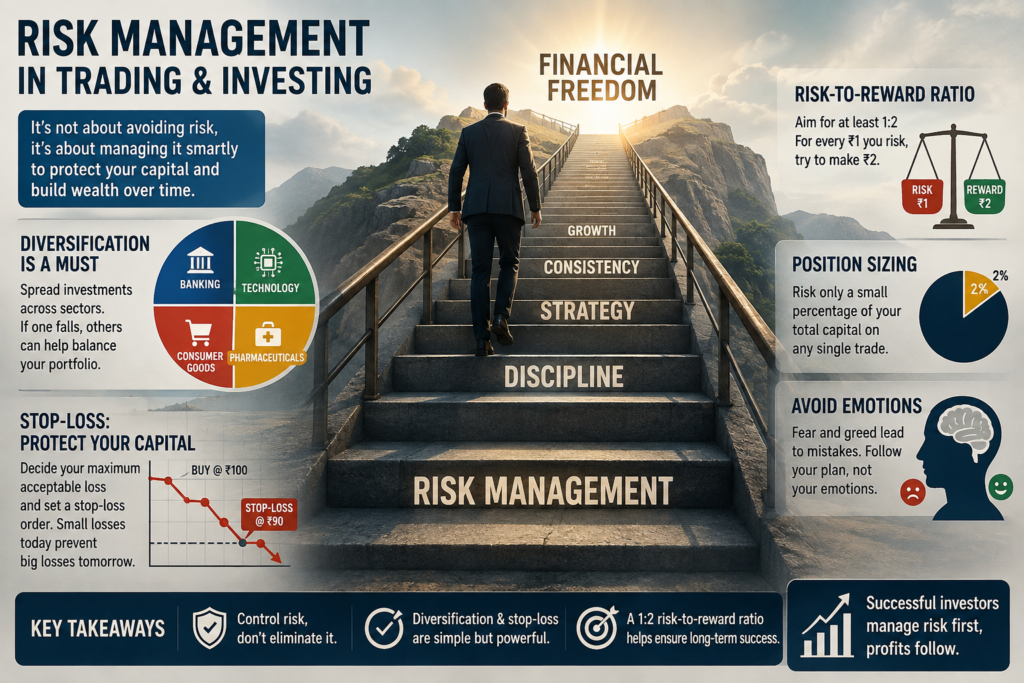
The Importance of Risk Management in Trading and Investing
Risk management is like the railing on a staircase — it isn’t there to hold you back, it’s a safety measure in case something goes wrong. It lets you climb higher without worrying about falling. Managing risk in the stock market works the same way: it’s about identifying potential risks and putting safeguards in place, not about avoiding risk altogether.
What Is Risk Management in Trading?
Risk management is the process of identifying, assessing, and controlling potential losses before they happen. It doesn’t eliminate risk — no strategy can — but it limits how much any single decision can hurt your overall portfolio.
Key Aspects of Risk Management
- Test the waters first: A common mistake among beginners is putting all their money into a single “hot tip.” If that one investment fails, they lose everything.
- Diversification is a must: Spread investments across sectors — some in banking, some in technology, some in pharmaceuticals. If one sector has a bad month, holdings in another sector help cushion the impact.
- The “stop-loss”: Suppose you buy a stock at ₹100, hoping it reaches ₹150 — but what if it falls instead? Deciding in advance how much you’re willing to lose, and placing an automatic order to sell at that price, keeps a small 10% loss from turning into a much larger one while you “hope” the price recovers.
- Risk-to-reward ratio: Compare the potential risk of a trade to its potential reward before committing. A good target is a minimum ratio of 1:2 — meaning for every ₹1 you risk, you aim to make ₹2 — so that your potential gains consistently outweigh your potential losses.
- Position sizing: Decide what percentage of your total capital any single trade should represent, so that no one position can cause outsized damage to your portfolio.
- Avoiding emotional decisions: Fear and greed are the two biggest drivers of poor trading decisions. A written plan — entry point, exit point, and stop-loss — helps remove emotion from the equation.
Why Risk Management Matters More Than Picking Winners
Even experienced traders lose on individual trades. What separates consistently successful investors from the rest isn’t a perfect win rate — it’s making sure no single loss is large enough to derail their overall progress.
Key Takeaways
- Risk management is about controlling risk, not eliminating it.
- Diversification and stop-loss orders are two of the simplest, most effective tools available to any investor.
- A 1:2 risk-to-reward ratio helps ensure gains consistently outweigh losses over time.
Frequently Asked Questions
- What is a stop-loss order?
A stop-loss is an automatic order to sell a stock once it falls to a predetermined price, limiting how much you can lose on that trade.
- What is a good risk-to-reward ratio for trading?
A commonly recommended minimum is 1:2 — risking ₹1 to potentially gain ₹2 — so that winning trades outweigh losing ones over time.
- Why is diversification important in risk management?
Diversifying across sectors and asset types means a downturn in one area doesn’t sink your entire portfolio, smoothing out overall returns.
Conclusion
Risk management isn’t the exciting part of investing, but it’s the part that determines whether you’re still in the game five or ten years from now. Build it into every decision, and the rest of your strategy has room to work.